
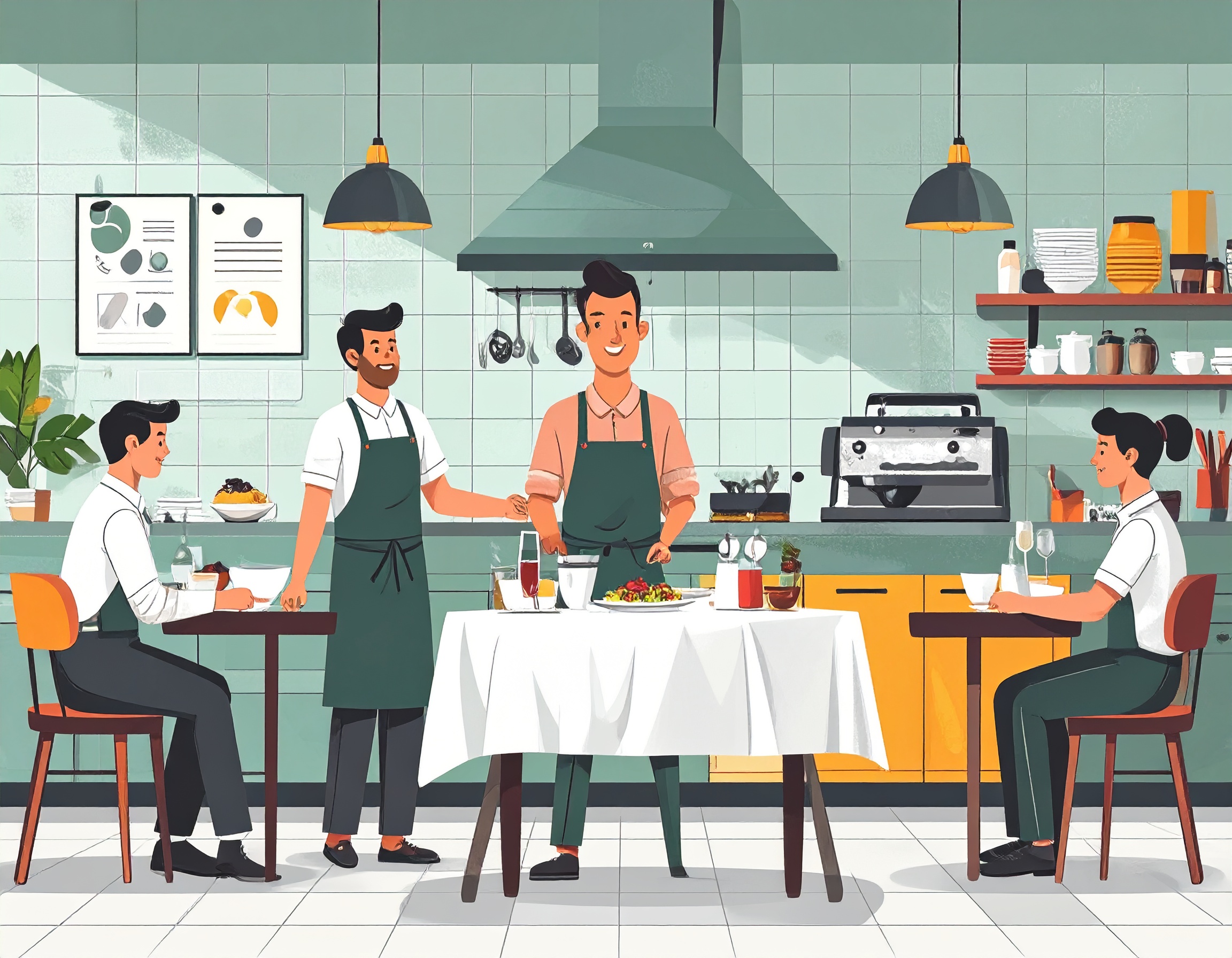
There is a common fear in the restaurant sector: "If I automate, I will lose the human touch that makes my special business."
The truth is exactly the opposite.
Well - done automation does not replace people — it frees people to be more human.
What is empathic automation?
Empathetic automation is technology that:
Understands the pace of human work
Reduce repetitive and mentally exhausting tasks
Maintains and amplifies moments of human connection
Adapts to user behavior
It's the difference between a system that requires you to change your operation and one that molds to your way of working.
The fatal error of most systems
Most management platforms for restaurants make the same mistake: automation without empathy.
They assume that:
Boys have time to type long texts in full running
Cooks will stop preparing food to move on the computer
Customers want to interact with complex interfaces
Restaurant owners have patience to set up 47 mandatory fields
The result? Expensive systems that nobody uses or that make the job more complicated.
How was Chefs thought differently?
Our platform was born of a simple question: "What really makes people tired in a restaurant?"
It's not physical work, it's the invisible cognitive effort:
Remember who asked what
Reorganizing priorities every minute
Translate information between people (garçom → kitchen → waiter → customer)
Managing expectations without information
Chefs was built to eliminate that effort.
Empathetic automation in practice: Chefs
1. For the waiter: clarity instead of memory
Traditional problem:
Waiter must remember: Table 5 has 4 people, the lady in blue asked for a bad steak, the gentleman in glasses asked chicken, the girl asked for salad, the boy still has not decided, while he attends table 7, 12 and 15.
Chefs solution:
The system automatically identifies each person on the table (A, B, C, D). The waiter does not need to memorize — the system remembers for him. When the dish is ready, the screen shows: "Mess 5-B: Filé mal passé". The waiter delivers without hesitation.
Human gain: The waiter can focus on smiling, talking and creating experiences.
2. For the kitchen: context instead of confusion
Traditional problem:
Cook gets paper with "Mess 12 - 3 Filés." You don't know which point each one, if it's urgent, or how long the table is waiting.
Chefs solution:
The kitchen display shows requests with full context: Table 12-A (bad past), Table 12-B (to the point), Table 12-C (well past). Visible waiting time and clear priority.
Human gain: The cook performs with precision and confidence.
3. For the customer: autonomy instead of dependence
Traditional problem:
Client wants to order dessert, but the waiter is busy. He waits 10 minutes, he gives up and asks for the frustrated bill. The restaurant loses sale.
Chefs solution:
The customer has access to a tablet on the table (autocustomer service mode) or can call the waiter with a touch. He chooses how he wants to be served.
Human gain: The client controls his experience, the waiter answers who really needs attention.
4. For the manager: visibility instead of assumptions
Traditional problem:
The restaurant owner doesn't know how many tables they turned today, which waiter is more overworked or which dish is taking longer. The decisions are based on "chisms".
Chefs solution:
The management panel shows real-time data: table occupancy, average time of customer service, best-selling products and operational gargalos.
Human gain: The manager makes decisions based on real data.
What makes Chefs different?
Designed for Brazilian reality
Many systems are translated from American or European models, ignoring how Brazilian restaurants really work. Chefs was born understanding:
Shared tables
Divided accounts
Brazilian customer service rhythm
Diversity of operations
Interface that respects the user
Principle 1: If it takes more than three touches to do something common, it's wrong.
Principle 2: You're not well designed.
Principle 3: If it causes more doubt than certainty, it doesn't work.
Each screen was tested with real waiters, cooks and customers.
Adaptation, non-imposition
Chefs doesn't force you to change your whole process from day to night. It works in three ways:
Traditional mode: Just tables and waiters.
Hybrid mode: Tables + autocustomer service.
Command Mode: System of physical or digital controls.
The system adapts.
Practical results of empathic automation
Restaurants that have implemented Chefs in São Paulo have reported qualitative changes:
Statement (50 tables restaurant, South Zone):
"Before, my boys ended the shift mentally exhausted. Today, they work confidently. They know that the system does not let anything go. And that changed until the team's climate."
Statement (self-service, 120 places, Center):
"I thought putting the tablet would cool down the customer service. It was the opposite. The waiter can talk to the customer, explain special dishes and suggest dessert."
Testimonial (family pizza place, Eastern Zone):
"The system gave me visibility that I never had. I found that calabresa pizza took 8 minutes more than a daisy. I adjusted the process, I reduced wait."
The balance between machine and human
Empathetic automation is not about replacing people. It's about positioning people where they make real difference.
Tasks the system does best:
Remember details
Calculate Values
Monitor Times
Synchronize information
Record History
Human tasks do better:
Perceiving emotions
Adapt customer service to customer humor
Solving unexpected situations
Create Connection and Memories
Use common sense
Chefs take care of the first list so your team shines on Monday.
Why does it matter now?
The food sector in São Paulo is at a turning point:
Shortage of skilled labour
Minor margins
More demanding customers
Increasing competition
In this scenario, operational efficiency ceased to be an advantage and became a prerequisite.
But efficiency without humanization is McDonald's. And not every restaurant wants to (or should) be McDonald's.
The future belongs to those who can climb excellence without losing their souls.
Conclusion
Empathetic automation is not about having a sophisticated system. It's about having a system that understands that:
Boys are not robots
Cooks work under pressure
Customers want choice
Owners need clarity
Chefs was built with this philosophy. Each functionality exists to reduce friction and amplify humanity.
Because in the end, what makes the customer come back is not the system — it is the feeling of being well attended to.
And a good system is the one you don't understand, but you feel the result.
In the next chapter: As real-time data transform intuition into strategy (and increase profit without increasing price).
You want to understand how Chefs works in your type of operation?