
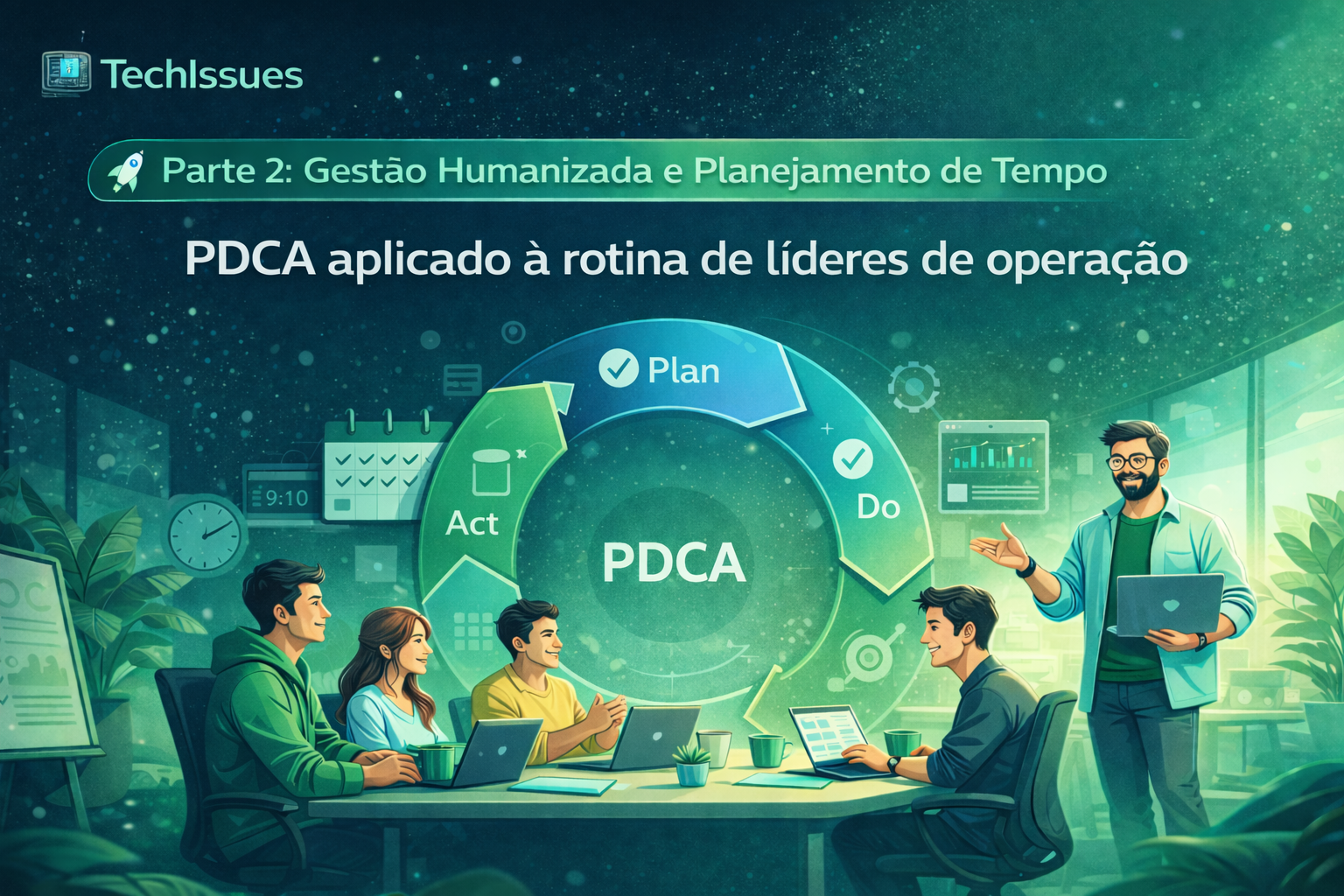
The cycle that never stops
Every operational leader has a paradox:
You need to constantly improve the processes, but you don't have time to stop and think.
You need to solve recurring problems... but every day is to put out a fire.
You need to delegate, but it's faster to do it myself.
And at the end of the month, look back and see: It's changed a lot, but nothing really changed..
That's where the PDCA — a Japanese method created in the 1950s in Toyota that revolutionized quality management around the world. And that can revolutionize YOUR routine as well.
The best part? You don't need certification, expensive consulting or stop the operation. The PDCA works precisely because it is simple, practical and fits in the middle of chaos.
What is PDCA (in human language)
PDCA is a 4-step cycle that is repeated continuously:
📋 P — Plan (Planning)
🚀 D — Do (Do)
🔍 C — Check (Check)
⚡ A — Act (Agir)
Translated into a restaurant day by day:
Plan: Identify a problem and plan how to solve it.
From: Test the solution (on a small scale, without turning the restaurant upside down).
Check: Check if it worked (with data, not with text).
Act: If not, adjust and start again.
Quick example:
P - "The requests of table 5 always take time because it is far from the kitchen."
D - "I'll test to put the X waiter in this area only for a week."
C - "The average delivery time fell from 18min to 12min."
A — "I will standardize: areas further = dedicated waiter."
Simple, measurable, replicable.
Why Operation Leaders Need PDCA
Because you guys don't have the luxury of making big mistakes.
In a corporate office, you can test a strategy for 3 months before you validate. In a restaurant, you have to test, validate and adjust in the same week — because next weekend is coming.
The PDCA gives you structure for:
✅ Solving root problems (not just to put out fires)
✅ Test changes without risking everything
✅ Measuring results with clarity
✅ Engaging the team in the process (not just "top orders")
✅ Creating continuous improvement that does not become chaos
PDCA in practice: 5 real restaurant situations
Situation 1: Boys always "forget" order items
❌ No PDCA:
"You need to pay more attention! I'll start taking off the salary."
→ Result: Bad climate, problem continues.
✅ With PDCA:
P — Plan:
Why does that happen?
I find: the system tablet is with cracked screen and makes reading difficult.
D — Do:
I'll trade the tablet for a week of testing.
C — Check:
Request errors fell from 12 to 3 a week.
(Use system data to confirm.)
A — Action:
I'll trade all the tablets.
Lesson: The problem wasn't the team, it was the tool.
Situation 2: Kitchen late on weekends
❌ No PDCA:
"I'll put another cook on Saturdays."
→ It increases cost, but the gargalo continues.
✅ With PDCA:
P — Plan:
Data analysis shows: the delay is not general. It is only in the dishes that use frying.
Reason: only one fryer.
D — Do:
Test to reorganize the menu: on weekends, I reduce 2 fried dishes and offer 1 special grilled dish.
C — Check:
Average preparation time falls 8 minutes.
"Distance" claims fall 40%.
A — Action:
I master the seasonal menu. I evaluate investing in 2nd fryer if the movement grows more 20%.
Lesson: Sometimes it's reorganisation.
Situation 3: Team does not follow the customer service pattern
❌ No PDCA:
"I'm gonna print out a 20-page manual and everybody has to read."
→ No one reads. Nothing changes.
✅ With PDCA:
P — Plan:
I identify the 3 critical points: greeting, response time, farewell.
I decide to focus on one at a time.
D — Do:
Week 1: Focus on greetings only.
I'm having a meeting 10 minutes before shift: "Today we're gonna make sure every table is greeted in up to 2 minutes."
C — Check:
At the end of the week, I ask for customer feedback and cross-reference with the system data.
customer service score rises from 4.2 to 4.6 (Google Reviews).
A — Action:
I'll keep the greeting pattern. Next week: focus on response time.
Lesson: Small, constant and measurable change works better than "unknown giant manual".
Situation 4: Turnover high of the waiters
❌ No PDCA:
"This generation doesn't want to work."
→ Problem continues, recruitment cost explodes.
✅ With PDCA:
P — Plan:
Exit interview: 80% of applications for resignation cite "exhaustive day" and "lack of recognition".
D — Do:
Test 2 changes for 1 month:
6h scales with 1 15min pause (instead of 8h races).
Public "Weekly praise" (not just criticism).
C — Check:
In two months, zero layoffs.
Team reports "better in the climate" in anonymous research.
A — Action:
I master the scales and the recognition system.
Cost of recruitment falls 70% in the quarter.
Lesson: Retaining talents comes cheaper than hiring.
Situation 5: Waste of high food
❌ No PDCA:
"I'll cut the portions."
→ Client complains, evaluation falls.
✅ With PDCA:
P — Plan:
I'm analyzing what's left over.
Discovered: it is not the portion. It is the accompaniment (rice and potato together).
D — Do:
Text: Client chooses 1 track or pays +R$3 for 2.
C — Check:
95% choose only 1.
Waste falls 30%.
Margin of profit goes up (because whoever wants the two pays more).
A — Action:
Mastership on the menu.
Investment in sustainability campaigns: "Conscious restaurant".
Lesson: Small adjustments have a big impact.
How to apply PDCA without becoming an "academic project"
The mistake of many people is to turn PDCA into a bureaucratic monster.
You don't need:
PowerPoint of 50 slides
3 hour meeting
Approval Committee
You need:
1 clear problem
1 small test
1 way of measuring
1 decision after the test
Example of "slip" PDCA:
Step
Action
Time
P
Identify problem in quick meeting (10min)
Monday
D
Test solution in practice
Tuesday Saturday
C
Check system data on Sunday
Sunday
A
Decides: Standardizes, adjusts or discards
Monday
1 week. 1 cycle. 1 improvement.
The Role of Technology in PDCA
This is where a management system well used become the leader's best ally.
Because the PDCA depends on dataNot achism.
Practical examples:
📊 No. P (Planning):
System shows report: "Measures 8, 9 and 10 have time of customer service 30% higher."
→ You clearly identify the problem.
📊 No C (Check):
After testing a change, the system compares: "Medium time fell from 18min to 14min."
→ You validate the solution with numbers, not with printing.
📊 In A (Agitate):
System allows standardization (e.g. adjust table layout, reorganize scales).
→ Improvement becomes standard, not "passenger mode".
But attention:
System doesn't replace conversation with the team. Data shows "what," but only people explain "why."
PDCA is not just for trouble — it's for opportunities
A lot of people use PDCA only when something goes wrong.
But it works even better for boost what's good already.
Example:
The X dish is the best-selling (system shows this).
P: What if I create a premium variation of his?
D: Two-week test on the special menu.
C: Sells 40 units in the first week.
A: I include it in the fixed menu, increasing average ticket by 15%.
That is: PDCA serves to correct and innovate.
The trap of "infinite perfectionism"
There's a leader who gets stuck in the cycle:
"I'll plan a little more..."
"I'll wait for the perfect time to test..."
"I'll analyze more data before I decide..."
And then nothing happens.
PDCA is not about perfection. iteration.
Better to test something 80% good and adjust than to plan something 100% perfect and never get out of the paper.
PDCA motto:
"It's better than perfect, and tested is better than planned."
Engaging the team in the PDCA (without becoming an endless meeting)
PDCA works best when the team participates.
But "participating" doesn't mean "two-hour meeting every week."
Practical ways to involve the team:
Digital Suggestion Box (WhatsApp, quick form)
"What problem do you think we should solve this week?"
Check-in 10 minutes before shift
"Last week we tested X. Did it work? What to adjust?"
Protagonism No. D (Doing)
"Fulano, you've identified the problem. Do you want to lead the test of the solution?"
Public recognition in A (Agir)
"Thanks to Cyclane's idea, we've cut waste by 20%.
Result:
Team feels it is part of the solution (not only executes orders).
Engagement goes up. Ideas come up from the bottom up.
PDCA for the leader himself
PDCA is not just about improving processes. you as leader.
Example:
P: "I realize I blow up with the team when I'm out of lunch."
D: "I'll test: lunch EVERY DAY for two weeks, even on the run."
C: "I didn't have any explosions, "and the crew even said I was calmer."
A: Lunch is a rule, not a time.
Another example:
P: "I'm doing everything alone and getting exhausted."
D: "I'll delegate cash-closing to the sub-manager for a week."
C: "He managed to do it, I left an hour early, nothing caught fire."
A: "Delegation becomes standard."
Self-care also enters the PDCA.
Conclusion: Continuous improvement is not overloaded — it is release
PDCA seems like one more thing to do, but actually is what frees you from the endless rush.
Because when you have a method:
Stop burning and start to prevent it.
Stop finding guilty and start solving cases.
Stop doing the same things waiting for different results.
And the best: you don't need to become "management specialist" to apply.
Enough:
Identify 1 problem a week.
Test 1 small solution.
Measure with simple data.
Decide: keep, adjust or discard.
1 cycle per week = 52 improvements per year.
And at the end of a year, you look back and see that Your restaurant is not the same anymore — without need of revolution, only of constant evolution.
Next article: Eisenhower's matrix and the chaos of priorities