
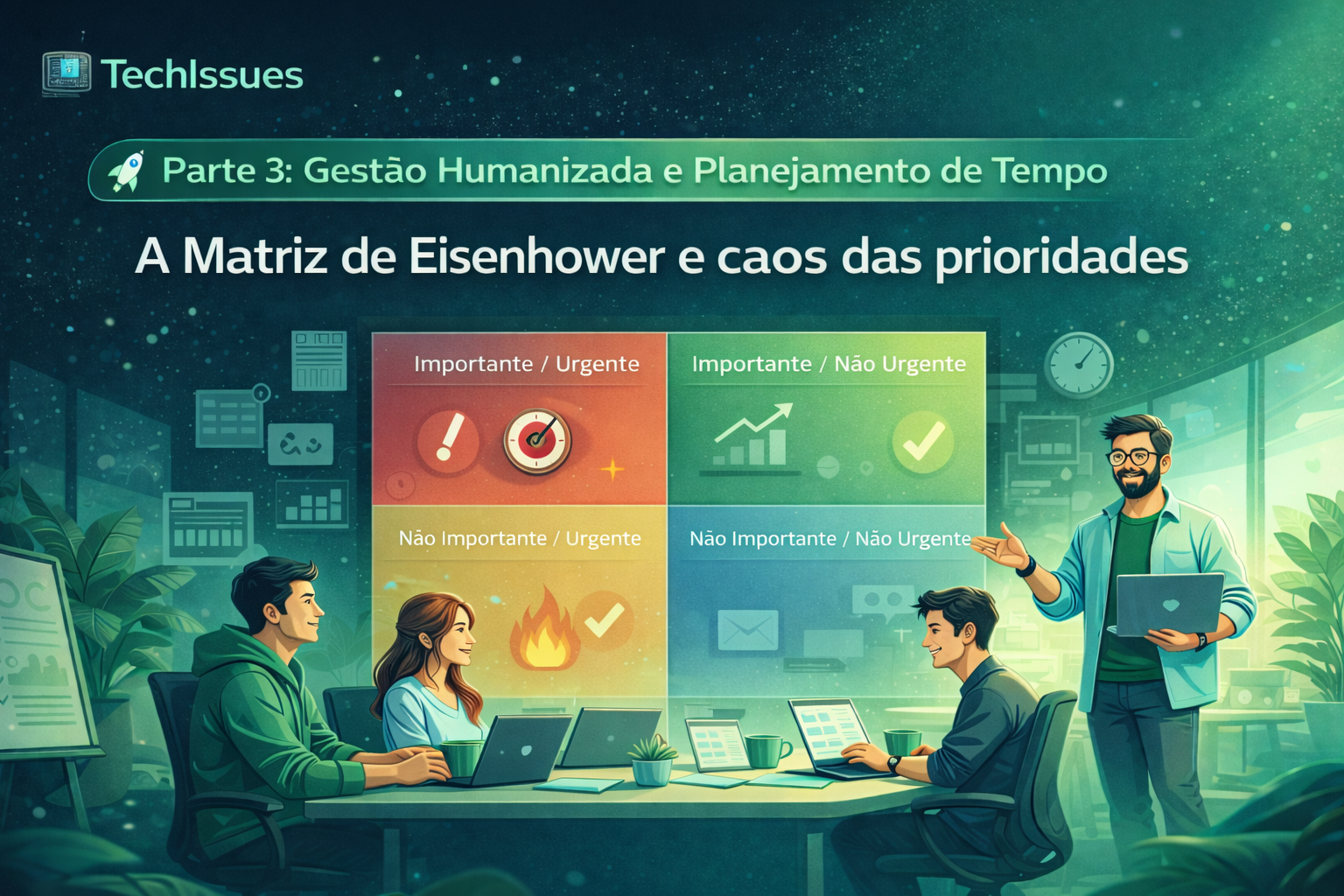
When everything is urgent, nothing is priority
6:00 p.m. Friday.
You need:
Close next week's scale
Solve a customer's complaint on Google
Check stock before weekend
Call the supplier who delayed delivery
Train the new waiter
Reply to the owner's WhatsApp
And there are still 40 tables to manage
Where does it start?
If your answer is "for the first thing you yell at me," you're not alone, and you're exhausted for one reason: You're confusing urgency with importance..
That's where the Eisenhower Matrix — a tool created by Dwight Eisenhower (general and former president of the US) that separates what really matters from what just seems to matter.
And no, you don't need to stop the operation to apply it. 2 minutes a day to look at your demands in a different way.
The Eisenhower Matrix explained in 30 seconds
The matrix divides ALL your tasks into 4 quadrants:
EMERGENT
NOT EARLY
IMPORTANT
Q1 - Do it already
Q2 - SCHEDULINGR
NOT IMPORTANT
Q3 - SINGLE
Q4 - ELIMINATE
Translated:
✅ Q1 (Urgent + Important): Crisis, emergency, critical deadlines → YOU DO IT NOW
📅 Q2 (Not urgent + Important): Planning, training, prevention → YOU'RE SCHEDULING (this is the quadrant of wisdom)
👥 Q3 (Urgent + Not Important): Interruptions, some connections, emails → YOU'RE DELEGATED
🗑️ Q4 (Not urgent + Not important): Distractions, social networks, gossip → YOU'RE A KIND OF END
The fatal error: living in Quadrant 1
Most operating leaders live 80% of the time in Q1 (urgent and important).
Examples of Q1:
Customer fighting in the hall
Wrong order leaving now
Staff member missing and no replacement
Payment system fell
Gas ended up in the middle of the rush
These things REQUIREMENTS No one questions.
But here's the problem:
If you live only by burning out (Q1), you will never have time to prevent the next fire (Q2).
And then you go into a vicious cycle:
No plans → More crises → Less time → No plans → More crises...
The forgotten quadrant: Q2 (the secret of the leaders who sleep well)
Q2 is where the life improvement The operation leader.
Examples of Q2:
Train the team (before she misses)
Create scales in advance
Do preventive maintenance of equipment
Plan Seasonal Cardboard
Review processes that generate rework
Having that difficult conversation with the employee (before it became crisis)
Taking care of your mental health
Why doesn't anyone do Q2?
Because there's no deadline, don't scream, don't burn.
So you postpone... until you turn Q1.
Real example:
Q2 (prevent): "I need to train the new waiter in the payment system."
❌ You postpone: "After I do, it's run today."
Q1 (disable fire): Waiter misses 3 payments on Saturday night, customer complains, you lose 1 hour solving.
Did you see the pattern?
20 minutes Q2 = 2 hours Q1 avoided.
How to apply the matrix to the actual routine (without complicated spreadsheet)
You don't need software, app or miraculous tool.
You need to 1 paper and 1 pen (or even mental).
Step 1: List ALL that you need to do today
Example of your Friday list:
Close next week's scale
Solve complaint in Google
Check Stock
Connect to supplier
Training new waiter
Reply to the owner's WhatsApp
Organize hall for rush
Update card in system
See sales report of the week
Step 2: Put each item in the matrix
Q1 - DOING NOW
Q2 - SCHEDULINGR
Organize hall for rush
Training new waiter
Connect to supplier (delayed)
Close next week's scale
Update card in system
Q3 - DELEGATE
Q4 - DISPOSAL
Answer the owner's WhatsApp (sub-manager can answer)
See sales report (can wait a second)
Solve complaint in Google (senior boy can do it)
Check stock (cooker can do)
Step 3: Act according to the dial
✅ Q1: You do NOW (before rush)
📅 Q2: You SCHEDULING (morning, Monday at 10am, etc.)
👥 Q3: You DELEGA (clearly, not throwing bomb)
🗑️ Q4: You're out of time.
Result:
You focused on what really mattered. You freed up time. And you still trained the team (delegating Q3).
5 real situations solved with the matrix
Situation 1: The WhatsApp that does not stop
You have 37 unread messages in the restaurant group.
Without the matrix:
You read them all, answer them all, stay 40 minutes on your phone.
With the matrix:
Client complaining = Q1 (solves now)
Donor requesting report = Q3 (asks sub-manager to send)
Waiter's Meme = Q4 (ignora)
Cook's Improvement Ideas = Q2 (Scheduling meeting of 10min second)
Time spent: Ten minutes. Effectiveness: 100%.
Situation 2: Broken equipment
The coffee machine broke (again).
Without the matrix:
You call the technician running (Q1) and forget to do preventive maintenance (Q2).
Result: Break it again next month.
With the matrix:
Q1: Solve now (technical comes today)
Q2: SCHEDULING monthly preventive maintenance (to avoid turning Q1 again)
Difference: Q2 avoids recidivism.
Situation 3: Staff with poor performance
Waiter X is making repeated mistakes.
Without the matrix:
You keep postponing the conversation (because "it's not urgent").
Until it becomes urgent: He's wrong, client complains, you need to resign in a hurry.
With the matrix:
Q2: Feedback Conversation (Today or Monday morning)
Q1 avoided: Major crisis in front
20min Q2 = resignation and recruitment avoided.
Situation 4: Meeting that could be an email
The owner sets up a meeting to "align strategy" at 11 am on Saturday (in the middle of the rush).
Without the matrix:
You go, get out of the operation, team gets lost.
With the matrix:
Analysis: Is it Q1? No. Is it Q2? Maybe. Is it Q3? YES (may be reZXTERM0ZXQdo).
You say, "Chief, can we do Monday at 3:00? Saturday is our critical time."
The owner understands, team thanks.
Situation 5: Social networks in the middle of the dossier
You take the phone "just to see a little something" and 20 minutes later...
Without the matrix:
Lost time, guilt, running later.
With the matrix:
Instagram = Q4 (elimine)
Answer system message = Q1 (does now)
See menu inspiration post = Q2 (save to see later)
Mental clarity = productivity.
The truth is hard: 80% of "emergencies" are not urgent
You know that WhatsApp:
"Ergent!!! I need to talk to you!!!"
Someone wants you to solve the DELA problem now.
But urgent for her urgent for you.
Always ask:
Does this need to be solved NOW or can you wait 30 minutes?
If I don't do it now, what's the real impact?
Can someone else handle it?
Examples:
❌ False urgency:
"Chief, you need to approve the post of Instagram now!"
→ Can wait. It's Q2 or up to Q3.
✅ Real emergency:
"Chief, client had allergic reaction!"
→ Q1. Immediate action.
Learn to say:
"That's important, but it's not urgent. Let's go Schedulingr to [time X]."
Error delegating everything (wrong Q3)
You have a leader who discovers Q3 and wants to delegate TO Q1.
That doesn't work.
Q3 = Urgent, but NOT important for YOU to do personally.
Example:
❌ Wrong delegation:
"Fulano, solve this client fight there." (That's your Q1, you need to show up)
✅ Right delegation:
"Fulano, confirm the reservation at 8:00 and let me know." (That's Q3, you don't need it)
Rule:
Only delegate Q3 if the person has ability and clarity.
Otherwise you create more trouble.
How to use the matrix to train the team (and get free)
The matrix is not just for you. Making better decisions.
Example in a quick meeting:
"People, when something urgent comes up, ask:
Is it crisis that only the manager solves? → Call me.
It's urgent but do you know how to solve it? → Solve and let me know later.
It's important but not urgent? → Write down and we'll talk after rush."
Result:
Team stop interrupting you for anything.
You stop being a giggle.
Matrix-friendly technology
A good management system helps you to identify automatically which is Q1.
Example:
📊 System shows:
"Mess 12 is 15min waiting for payment" → Q1
"Beer stock finishing" → Q2 (Answer before you finish)
"Sales report of the month available" → Q2 (analysis second)
No system: you have to ADIVIDE what is urgent.
System: He warns you.
But be careful:
Bad system turns false emergency generator.
Notification of everything = you ignore everything.
Configure only for what is really Q1.
The leader's matrix and self-care
Your health is Q2.
It seems obvious, but you treat as Q4 (leaves for later, eliminates, forgets).
Examples of personal Q2:
Sleep 7 hours a night
Do 30min exercise
Lunch sitting
Take 1 day off a week
Check-up doctor
"But I don't have time!"
You don't have time Why aren't you doing Q2?.
If you don't take care of yourself (Q2), soon you become an emergency (Q1):
Burnout
Disease
Emotional explosion
Bad decisions by exhaustion
Self-care is not luxury. It's strategic Q2.
Conclusion: The power to choose where to put your energy
Eisenhower's matrix doesn't solve all the problems.
But she gives you something every operation leader needs:
Clear.
Clarity about:
What to do first
What can you expect?
What to delegate
What to ignore
And in the midst of the chaos of a full restaurant, that clarity is the difference between:
. "I'm drowned, I don't even know where to start"
izza "I know exactly what is priority now"
So next time everything seems urgent:
Breathe.
Look at the list.
Question: Q1, Q2, Q3 or Q4?
You're on the same page.
And remember:
Whoever lives on Q1 alone dies early.
Whoever invests in Q2 sleeps quietly.