
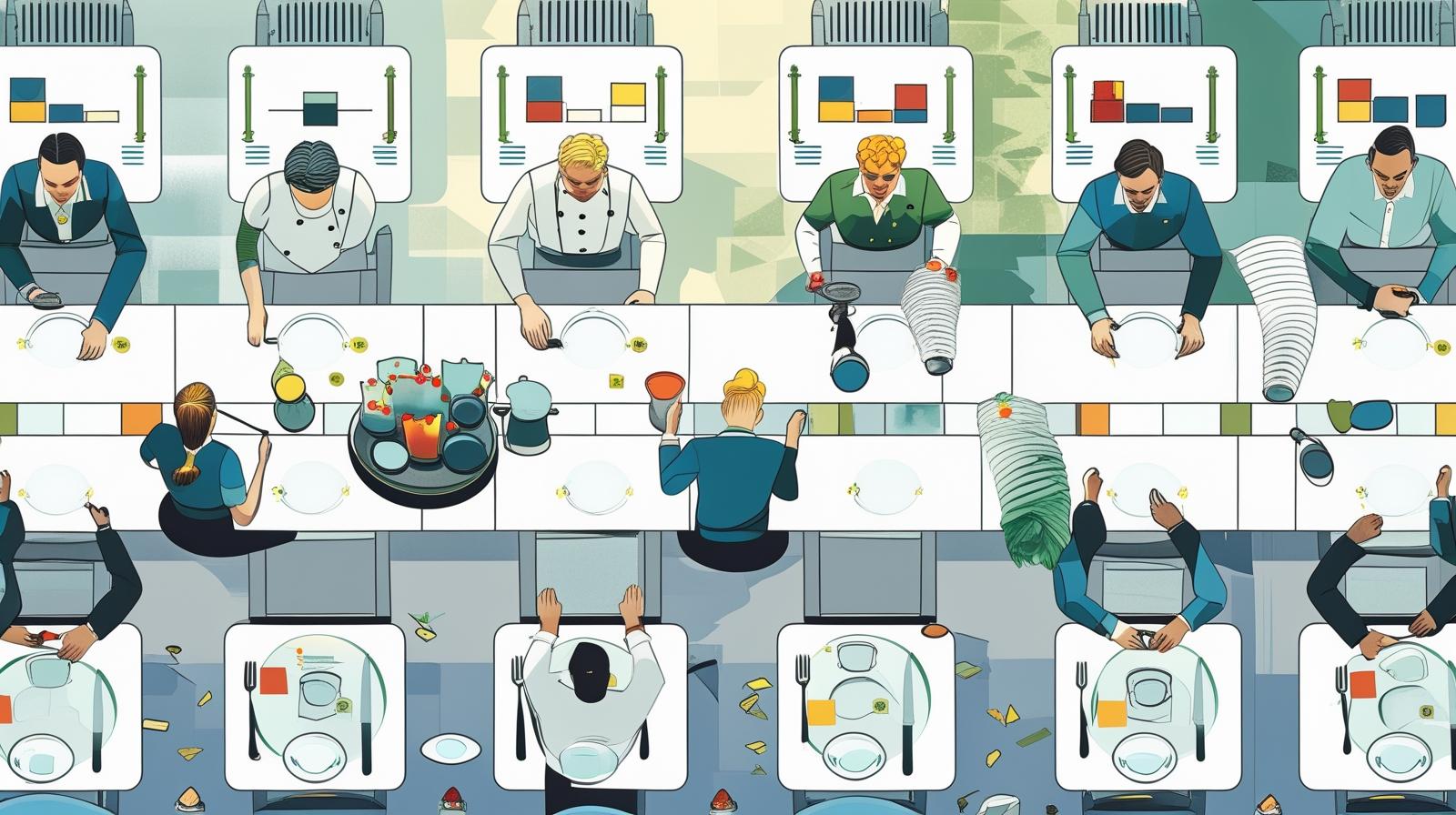
For decades, restaurants have treated "tables" as the basic unit of operation.
"Mess 5 ordered three plates."
"Mesa 12 has been waiting for 20 minutes."
"To take care of table eight."
The problem? Tables don't eat.
Treating 4 people as a "table" generates impreciseness, confusion and waste of opportunity.
The problem of granularity
Granularity is the level of detail with which you observe operations.
Low granularity:
"The table has ordered three different dishes."
High granularity:
"Person A asked for bad steak. Person B asked for grilled chicken. Person C asked for salad to fall."
The difference seems subtle, but the impact is enormous.
Real example: Table with 4 friends
Traditional system (low granularity):
Waiter notes: "Mess 7 - 2 steaks, 1 chicken, 1 fish."
Kitchen prepares the four dishes.
Waiter enough with the tray.
Question: "Who asked for the steak?"
It's embarrassing silence.
Waiter tries to guess, wrong.
Client corrects, weather gets weird.
Experience compromised.
Chefs system (high granularity):
Garçon records: Table 7-A (wrongly-dipped), 7-B (dipped), 7-C (frange), 7-D (fish).
Kitchen prepares knowing who is who.
Waiter comes and says, "I've been wrong for you, I've been wrong for you..."
Customer feels seen, remembered, respected.
Impeccable experience.
The difference is not just operational. emotional.
Why letters instead of names?
We could use full names. "João Silva asked for a bad steak."
But that would create new problems:
Waiter would need to ask each person's name (intrusive).
Delayed typing in running environment.
Mistakes in the handwriting ("John" vs. "Joao" vs. "Jhon").
Privacy issues (not every customer wants to provide the full name).
Chefs solution: Letter system (A, B, C, D...).
Advantages:
Quick to register (1 click).
It doesn't require personal information from the client.
Universally understandable (A, B, C works in any language).
Visual and intuitive (easy to see in the kitchen display).
Stable (it works for tables of 2 or 12 people).
The silent revolution of data
When you operate granularity per person, improve the customer service and unlocks data that previously did not exist.
1. Individual consumption patterns
Before:
"Mess 5 consumed R$ 340."
Now:
"Mesa 5 had 4 people. Persona A consumed R$ 120, B consumed R$ 95, C consumed R$ 80, D consumed R$ 45."
Insight unlocked:
You find that 25% of people in groups consume 50% of the value. You can create strategies to increase the average ticket of the other 75%.
2. Decision speed by profile
Before:
"It took mesa eight minutes to decide."
Now:
"Person A decided in 2 minutes. Person B took 12 minutes (assured every table)."
Insight unlocked:
You realize that tables with children (person C) take 40% more to decide. Solution: simplified children's menu or quick suggestions.
3. Account division without friction
Before:
Client: "Everyone pays his."
Waiter: "Who asked what?"
The whole table tries to remember, five-minute discussion, rough count, someone always pays more.
Now:
The system already knows who asked what (from the beginning). Automatic division. Client Pays R$ 78, Client B pays R$ 92, Client C pays R$ 54. Each pays exactly what it consumed. Zero friction.
Impact:
Closing time reduced by 70%. Table releases faster. Next customer enters earlier. Spin increases.
4. Customized experience effortlessly
Scenario: Customer's coming back for the third time.
Traditional system:
Waiter doesn't remember what he asked for before (unless he has a superhuman memory).
Chefs System (with history):
The system can show: "Client returned. In the last two visits asked for bad steak with rustic potato."
Waiter can proactively suggest: "Will you want the usual steak or do you want to try our new dish?"
Customer feels special- Loyalty increases.
Important: This historical feature can be enabled or disabled according to the restaurant's privacy policy.
Cases of use beyond the obvious
Granularity per person opens up possibilities that go beyond "delivering the right dish":
Use 1: Allergies and dietary restrictions
Old problem:
Customer reports gluten allergy. Waiter notes, but forgets to warn the kitchen. Plate comes with bread. Client complains. Restaurant needs to redo, customer becomes insecure.
With Chefs:
Allergy is registered in the specific person (Person B - gluten-free). It appears prominent on the kitchen display. Cannot ignore. Food security guaranteed.
Use 2: Corporate events and large groups
Scenario: Table of 12 persons (meeting of the company).
Traditional problem:
Waiter writes 12 requests on paper. Kitchen does not know the order of arrival. Plates come out disorganized. Metade from the table eat while another waits.
With Chefs:
12 people = 12 identifiers (A up to L). Each order has timestamp. Kitchen prioritizes correctly. Plates come out logically. Coordinated experience.
Result: Companies are back for future events because the operation was flawless.
Use 3: Self-service with buffet + extra orders
Scenario: Restaurant with buffet for weight + drinks and à la carte desserts.
Traditional problem:
Client weighs plate (R$42.50). Sit. Ask for beer and pudding. When closing the account, waiter does not remember if that person asked for 1 or 2 beers. Constraining discussion.
With Chefs:
Persona A weightu buffet (R$ 42.50). Extra orders (brew, pudding) are automatically recorded in her profile. Counts close automatically: Buffet R$ 42.50 + Beer R$ 8 + Pudim R$ 12 = R$ 62.50. Zero discussion.
The change of mindset
The greatest impact of granularity per person is not technical — it is cultural.
Old mind:
"I have tables."
New mindset:
"I have people."
When the restaurant changes from table 5 to table 5 person A, something subtle happens:
The team thinks of individuals, not numbers.
The customer service naturally becomes more human.
Mistakes diminish because the context is clear.
The client feels unique, not part of a generic group.
That reflects on reviews, loyalty and recommendations.
The invisible competitive differential
Most restaurant management systems still operate in the logic of "meas as a unit".
Very few systems see person as a unit.
This creates a competitive advantage that is difficult to copy, because it is not just technology — it is change of operational paradigm.
Contestants may try to copy the interface, but if they don't change the internal logic, they will remain trapped in "table asked for 3 plates".
Chefs was built from the beginning with the person as center. It all comes from this architectural choice.
The numbers speak
Restaurants that have adopted the individual identification system report:
Operational:
83% reduction in dish delivery errors.
68% less time spent on "who asked what?".
54% faster in closing split accounts.
Experience:
41% more mentions in reviews about "customer service attentive".
37% increase in recurring customers (fidelization).
29% more tips (team answers better, gets more).
Financial:
22% increase in extra orders (over-monthly, drinks).
18% increase in average ticket (upsell facilitated).
31% more round table (faster closing).
Privacy and control
A legitimate concern: "Are you tracking customers?"
Clear answer:
The letter system (A, B, C, D) is by default. When the table closes, identifiers are discarded. There is no tracking between visitors unless the restaurant explicitly enables a loyalty program (and the customer consents).
Privacy principles:
Data belongs to the restaurant, not the platform.
The customer can request deletion of his/her history at any time.
Identification serves the operation, not invasive marketing.
Total transparency about what is stored.
Conclusion
The revolution in table data is not about collecting more information.
It's about see what was always there — real people with specific requests, individual preferences and unique expectations.
When you leave table five and go to table five A, you're not just improving the system.
You are. Humanizing the operation.
And in the end, restaurants don't compete for the best technology. feel more special.
Technology that treats each person as an individual (instead of table number) wins.
In the next chapter (FINAL): The future of restaurants in São Paulo — where the sector is moving and how to prepare.
You want to see how it works in practice? Let's talk.