
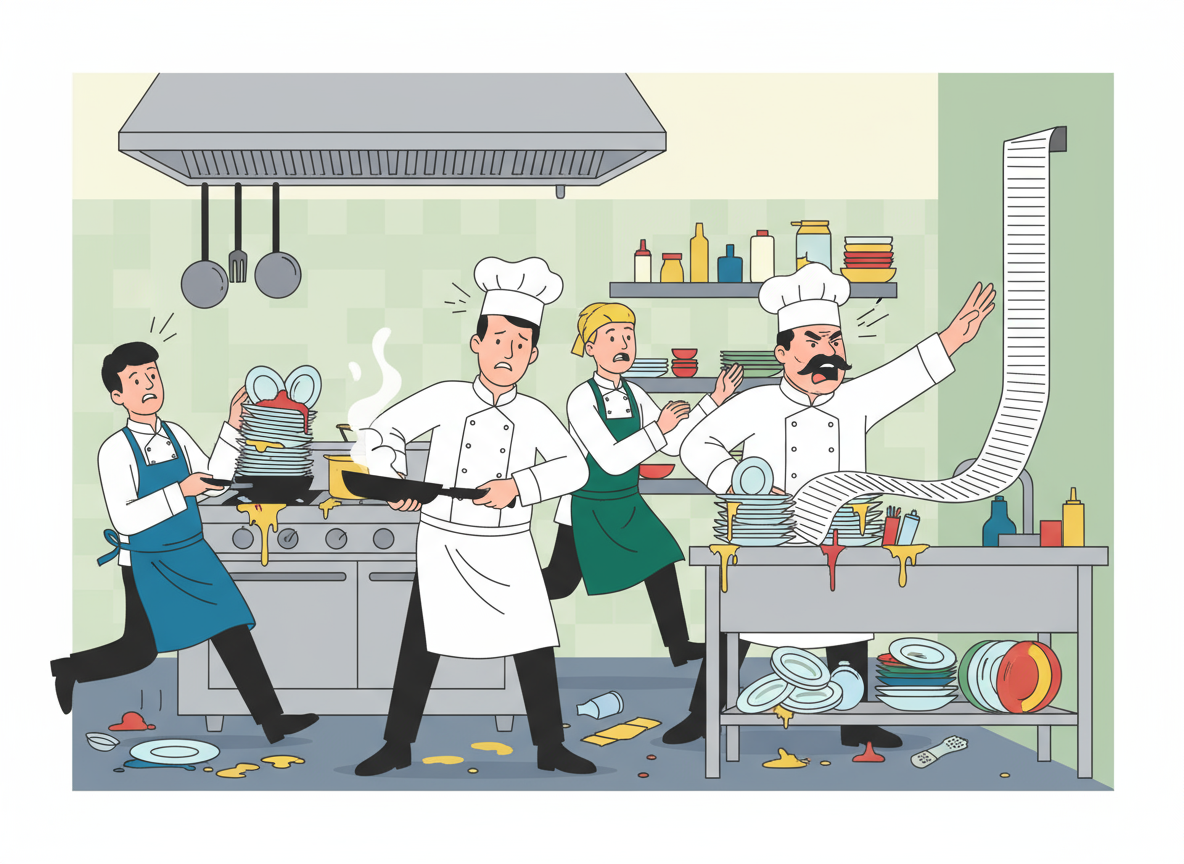
If the table is already a big mess, in the kitchen the chaos is multiplying. The waiter notes "Mess 5 - 2 Filés, 1 ill past", but forgets to identify who asked each dish. The result? The cook prepares, the waiter delivers and the answer on the table is: "I didn't ask for that!".
The invisible problem: the kitchen is in the dark
While the restaurant is concerned with the quality of the ingredients and the chef's technique, a structural problem goes unnoticed: the communication between the waiter and the kitchen.
Data show that 294 complaints of delay and 374 of lower perceived quality (Mister O. Hidden Client . . Evaluations throughout Brazil) do not refer only to food — they are about broken processes.
Look what happens behind the scenes:
Request arrives incomplete
The waiter notes "Mesa 12 - 3 plates", but does not identify who asked what. The kitchen prepares without context.
Lack of prioritisation
The kitchen guesses.
Constant Rework
The cook remodels, increases the turn time and irritates the customer.
Cognitive overload
The chef needs to remember 6 tables, 18 people, 24 dishes and special changes ("without onions", "bad past"), all at the same time, in high pressure environment.
The real cost of chaos in the kitchen
It's not just about stress. Lost money:
Wasted time: Every minute of confusion reduces the turn of tables.
Food waste: Remade or discarded dishes.
Client dissatisfaction: Delays generate negative reviews.
Turnover of employees: Stressed cooks apply for resignation.
In São Paulo, where the food sector moves R$ 416 billion/year, optimizing 10 minutes per table can mean 30% more billing at the same peak time.
How does our platform work?
Our system Chiefs was created to eliminate divination in the kitchen:
Clear identification of each customer
Each person on the table receives an ID (letter A, B, C...). The waiter records:
Table 12-A: Bad thread
Table 12-B: Thread well past
Table 12-C: Grilled chicken
The kitchen sees Exactly. who asked what, zero margin for error.
Real-time communication
Once the waiter confirms the request in the tablet/app:
✅ Kitchen display updates instantaneously (WebSocket)
✅ Requests appear in chronological order.
✅ Visible status: Pending → Preparing → Ready → Delivery.
Categorization and intelligent filters
Kitchen can filter by category:
Meat: See only meat orders.
Drinks: Bar sees only drinks.
Desserts: Confectionery sees only sweets.
Each sector works focused on what matters, without visual pollution.
Automatic prioritization
System orders requests by:
Waiting time.
Emergency (full table waiting).
Number of people impacted.
The chef knows what to do first.
The practical difference
BEFORE (traditional system):
Waiter yells, "Mess 5! Three plates!"
Kitchen: "Who asked what?"
Waiter (looking at confusing note): "Ah... I think it was the one on the tip..."
🔴 Result: Wrong dish, irritated customer, rewrap.
LATER (with our system):
Waiter registers in the app: Table 5-A, 5-B, 5-C.
Kitchen display shows: "Mesa 5-A: Filé mal paste."
Cook prepares with total clarity.
✅ Result: Right dish, fast delivery, satisfied customer.
Measurable impact
Customers who have implemented the system report:
✅ -67% errors In the kitchen.
✅ +40% speed in preparation (without re-work).
✅ +25% turn Tables (customer service faster).
✅ -50% stress of the team (clear process).
Why does it matter to São Paulo?
With tight margins and fierce competition, restaurants in São Paulo cannot afford to lose customers by avoidable errors.
While most invest in marketing and decoration, the winners invest in processes — because:
> Client forgets the nice dish, but he always remembers the delay.
Conclusion
The kitchen is not just the heart of the restaurant — it is the invisible gargalo which defines whether you will have profit or damage.
Reducing the team's cognitive effort, eliminating guesses and automating communication is not "technology by technology" — it is competitive survival.
Our system Chiefs It turns chaos into clarity, stress into fluidity and confusion into profit.
In the next chapter: As the autocustomer service reduces dependence on waiters (without losing the human touch).
You were curious to see the kitchen running in real time? Let's talk.